
Bubble or Breakthrough? Inside the $725 Billion AI Infrastructure Bet
The world's biggest tech companies are spending like never before on artificial intelligence. The world's most prominent investors can't agree on whether that's genius or delusion.
 Saurabh KhanAI & DevOps Engineer · Jul 11, 2026 · 14 min read
On June 25, 2026, Apple did something it had never done before. In the middle of a product cycle, with no new hardware to justify it, the company raised prices across its lineup. The MacBook Air went up by roughly 18%. Apple TV jumped 54%, and in some configurations more. iPad Pro climbed by about a fifth. Apple's shares fell more than 6% that day — its worst single-day drop in over a year.
The explanation was unusually candid for a company that prides itself on shielding customers from cost pressure. Apple said it had "never seen a component price increase this much this quickly," and admitted: "We've shielded our customers from these increases so far. But now we've reached a point where we need to begin raising prices."
The culprit wasn't a new chip or a tariff. It was memory — the ordinary DRAM that goes into every laptop, phone, and game console on Earth — caught in a global scramble that has almost nothing to do with consumer electronics. It's about data centers, and a bet on artificial intelligence so large that it is now bending the price of hardware for everyone else.
That bet has become the subject of an increasingly urgent argument among the world's most prominent investors: is this the greatest business wager in history, or the greatest bubble ever inflated?
A capex boom without precedent
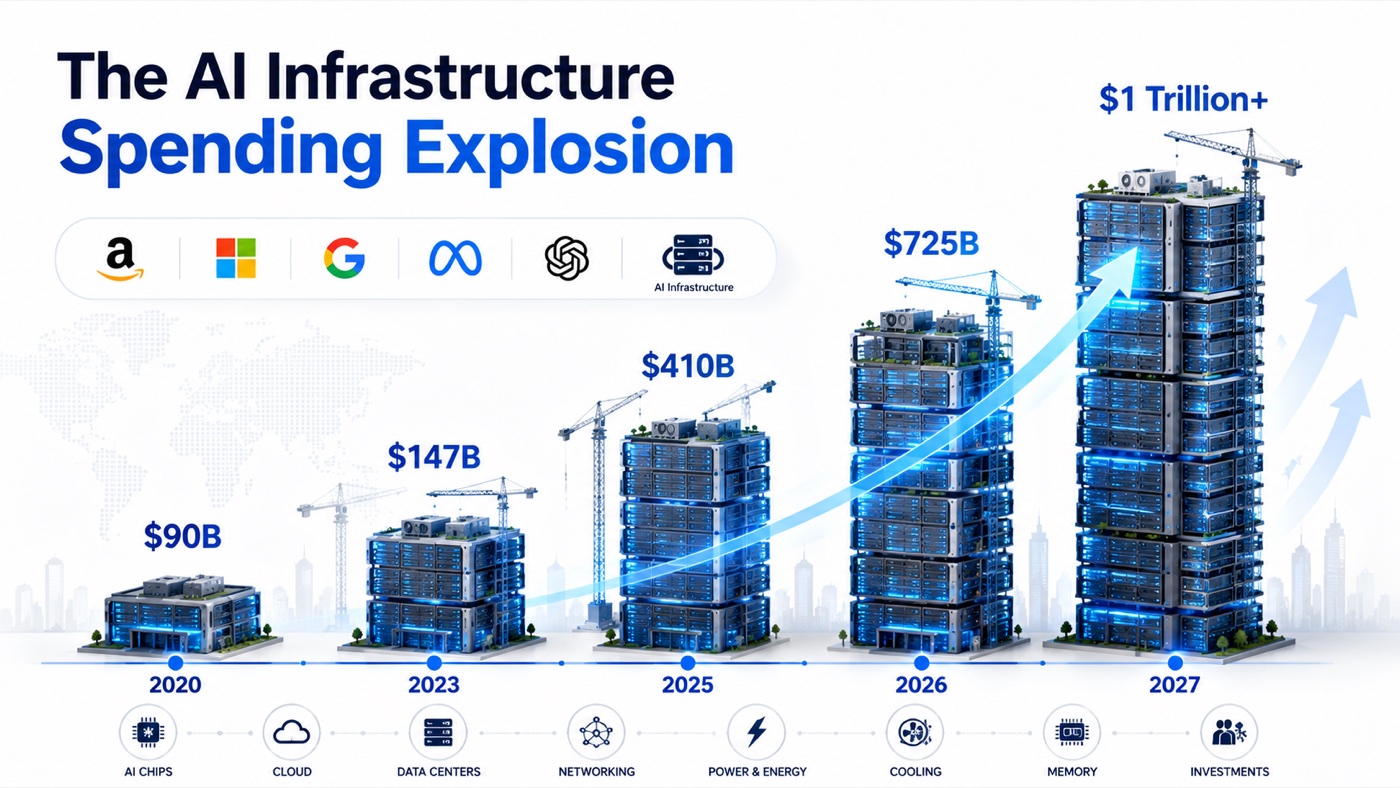
Start with the scale of the spending. In 2020, before ChatGPT existed, the four biggest US tech companies — Amazon, Meta, Google, and Microsoft — spent a combined $90 billion on capital expenditure. By 2023 that had risen to $147 billion. In 2025 it reached roughly $410 billion. In 2026, the five largest Western hyperscalers are on pace to commit around $725 billion to capex, most of it AI infrastructure — an eightfold increase in six years, and a trajectory analysts expect to top $1 trillion annually by 2027.
For a few weeks in the spring, the stock market treated this as unambiguously good news. On May 13, 2026, Nvidia became the first company in history to reach a $5.5 trillion market capitalization. Analysts were falling over themselves to recommend AI stocks for the year ahead.
Then, in late June, something cracked. Nvidia's value slipped back under $5 trillion. Micron fell more than 13% in a matter of days; SanDisk dropped over 10%; Apple fell 6.1% on the price-hike news; SoftBank tumbled 12%. OpenAI, which had been expected to go public in 2026 at a valuation approaching $1 trillion, was reported to be delaying its IPO to 2027, reportedly rattled by market volatility and a wobbly debut from another high-profile listing. Warnings started arriving from people who don't warn lightly.
Ray Dalio, founder of Bridgewater Associates, has said the AI boom is running at "about 80%" of the euphoria that preceded the 1929 crash and the 2000 dot-com collapse, and describes it as a "textbook" example of the pattern that has accompanied every major technological wave — railroads, personal computing, the internet. Michael Burry, the investor made famous by his bet against subprime mortgages, has taken short positions against Nvidia and Palantir, arguing that today's AI stocks have risen even faster over twelve months than the leaders did just before the dot-com peak. Jeff Bezos has offered a more measured view, calling it "a kind of industrial bubble" rather than a purely financial one — the type that leaves behind real, useful infrastructure even after the companies that built it go bankrupt — while adding in May 2026 that investors "shouldn't worry about it" because much of the investment "is going to turn out to be very healthy."
That range of opinion, from three people who study capital cycles for a living, is itself the story: nobody serious is claiming certainty in either direction.
What, exactly, is being built
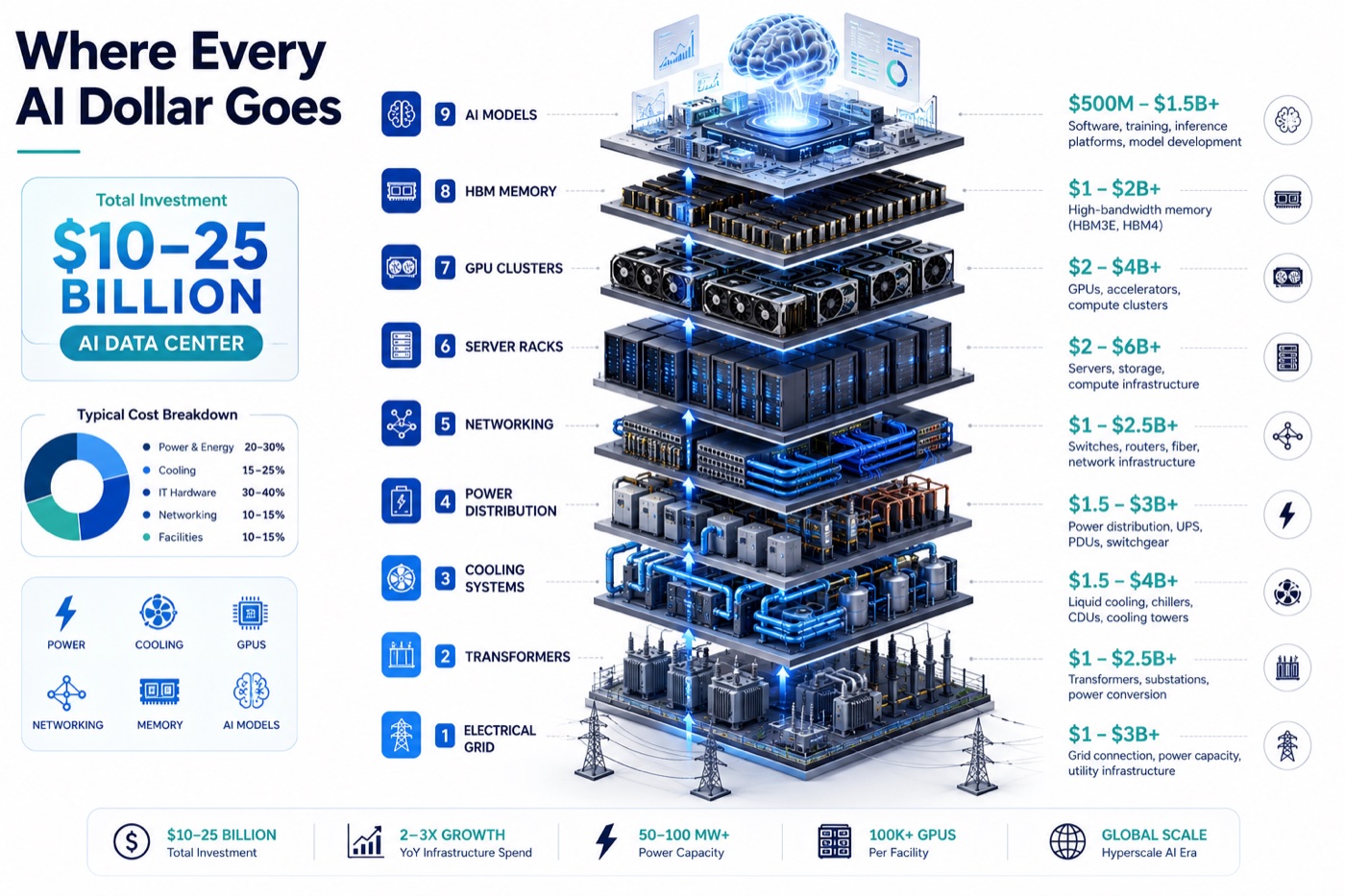
It helps to understand what the money is actually buying. When a user types a question into an AI chatbot, the answer isn't generated on their phone — the phone is just a screen with a Wi-Fi connection. The computation happens in a data center: a windowless industrial warehouse filled with racks of specialized chips, principally Nvidia's GPUs. A large facility can house on the order of 100,000 of these processors. At $30,000 to $40,000 per chip, the silicon alone in a single building can run $3–4 billion — before accounting for the power infrastructure, cooling systems, high-speed networking, and construction needed to run it. All in, a large AI data center can cost $10–25 billion to build.
The justification for building so many of them is a genuinely staggering data trend. In 2010, the world generated roughly two zettabytes of data — about two trillion gigabytes. By 2026, that figure is projected to reach 221 zettabytes: more than a hundredfold increase in sixteen years. The pitch to investors has been straightforward — if data and demand for intelligence are compounding this fast, the compute to process it needs to compound just as fast, or faster.
The math that makes analysts nervous
Here is the number that has unsettled even AI optimists. According to PIMCO, capital expenditure is on pace to consume 94% of hyperscalers' operating cash flow in 2026, up from just 40% in 2023. In plain terms: for every $100 the largest tech companies earn, $94 is being plowed straight back into AI infrastructure, leaving $6 for dividends, buybacks, raises, and everything else.
That spending is a bet that demand for AI compute will, within a handful of years, make today's prices look cheap. JPMorgan tried to size up whether the bet pencils out. Its analysts calculated that to deliver just a 10% return — the baseline any serious investor would require — the AI buildout needs to generate about $650 billion in incremental annual revenue. For context, JPMorgan noted that's roughly equivalent to charging every iPhone owner on Earth an extra $35 a month, forever, or every Netflix subscriber an extra $180 a month, forever.
Sequoia Capital's David Cahn ran a similar exercise back in 2024, when he coined what became known as "AI's $600 billion question." By 2026, as the capex numbers ballooned, Cahn had revised his own math upward: on his updated estimate, the industry now needs to justify roughly $3 trillion in annual revenue against $1.5 trillion in projected 2026 infrastructure spending.
So how much is AI actually earning today? OpenAI's revenue run rate sits around $25 billion a year, against a projected 2026 loss of roughly $14 billion, with the company not expecting profitability before the end of the decade. Anthropic has grown faster, crossing a run rate above $45 billion by mid-2026 and nearing its first profitable quarter. Google's Gemini is estimated in a similar range. Add it up, and the entire frontier AI model industry generates somewhere in the neighborhood of $75–100 billion a year — against roughly $725 billion being spent annually on the infrastructure to run it, and against the $650 billion (or, on Cahn's revised numbers, far more) that would be needed to justify it.
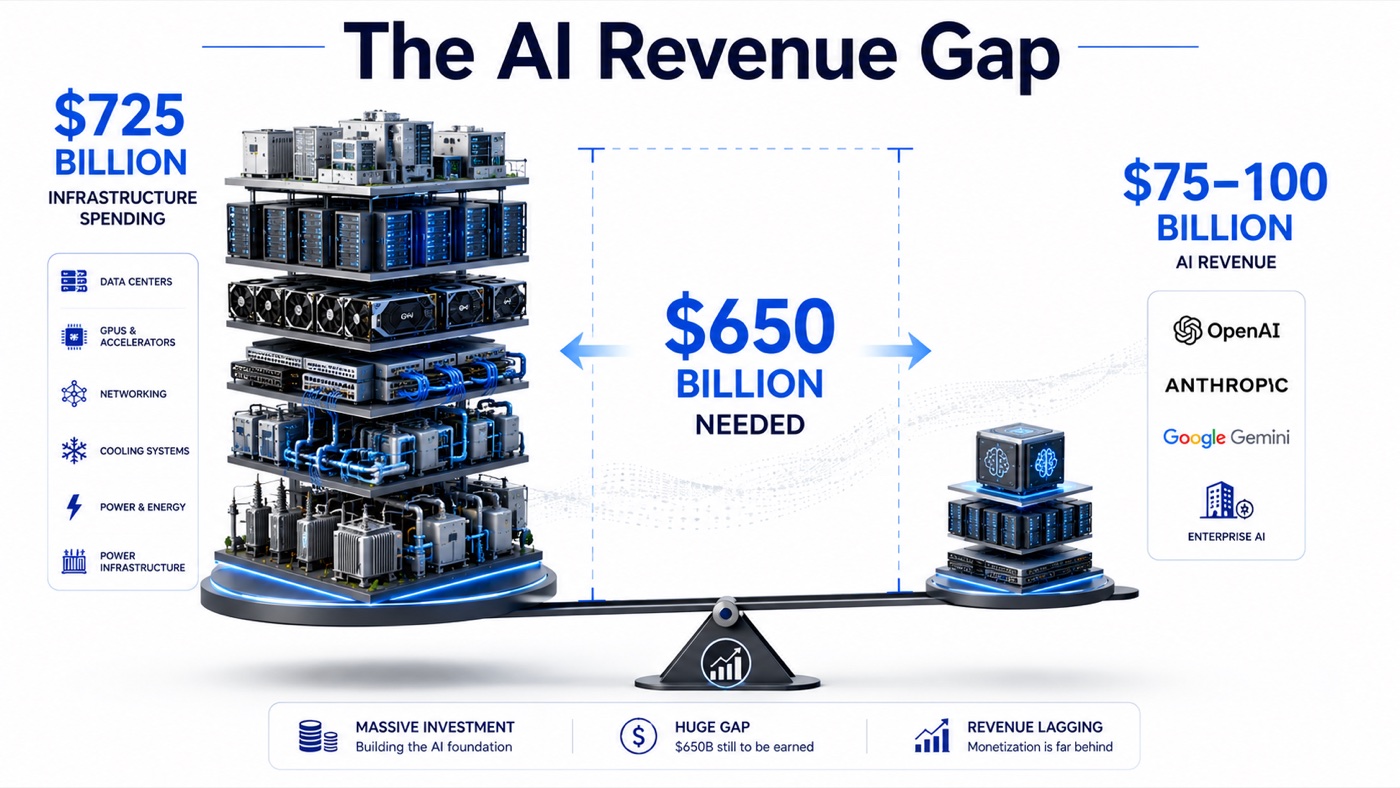
To put that gap in a more human frame: imagine spending $10 million to build a factory that goes on to sell $400,000 worth of product a year. Nobody would call that a good investment, let alone build a second factory next door. That, roughly, is the ratio AI infrastructure spending currently sits at relative to AI revenue — and it is why Sequoia's "$600 billion question," even in its original, more modest form, still circulates as shorthand for the industry's central unresolved problem: a large annual revenue gap that nobody has yet identified who will fill.
The obvious rebuttal — and why it's shakier than it sounds
The standard answer to all this is that enterprises will eventually pay for AI once it makes them efficient enough to justify the cost. That case looked strong right up until 2026 delivered a string of contrary data points. Research circulating from McKinsey, BCG, and MIT throughout 2025 found startlingly similar conclusions: a large majority of enterprise AI deployments were failing to hit their projected return on investment, only a small minority of companies were seeing substantial ROI, and fewer than a third of executives could even reliably measure the return they were getting.
The clearest illustration came from Flo Crivello, CEO of the roughly 25-person AI startup Lindy, who told CNBC in June 2026 that his company was spending more on Anthropic's Claude API than on its entire payroll. Lindy's response was to move 100% of its AI traffic to DeepSeek, cutting its inference costs by a reported 90% and calling the switch "a matter of survival for the business." Around the same time, Uber's leadership disclosed that the company had exhausted its entire 2026 AI budget in about four months after aggressively rolling out AI coding tools, prompting it to cap employee AI spending and, through its president and COO, openly question whether the spending was translating into anything customers could feel.
Then, on July 1, 2026, Palantir's CEO Alex Karp went further, telling CNBC that enterprise clients across his customer base were "livid" about being sold AI subscriptions that deliver little value: "They're stealing the weights and alpha of my business, and they're creating a wealth tax... something has gone completely wrong." Coming from the head of one of the most prominent enterprise software companies selling into governments, banks, and Fortune 500 boardrooms, it was a notable crack in the "enterprises will pay whatever it costs" thesis that has underpinned much of the AI trade.
The pattern across all three episodes is the same: as soon as the true cost of frontier AI became visible, sophisticated buyers looked for the exit, rather than accepting the price.
Who actually pays the difference
This is where the story stops being a rich person's problem. Memory chip manufacturing is dominated by three companies — Samsung, SK Hynix, and Micron — which together control roughly 90% of the world's supply. Ordinary DRAM, the kind in a laptop, and high-bandwidth memory (HBM), the kind AI data centers need, come off largely the same production lines. HBM sells for many times the price per module. Faced with that gap, the three manufacturers have reportedly shifted around 93% of their combined production capacity toward AI-grade memory, starving the consumer market of ordinary chips.
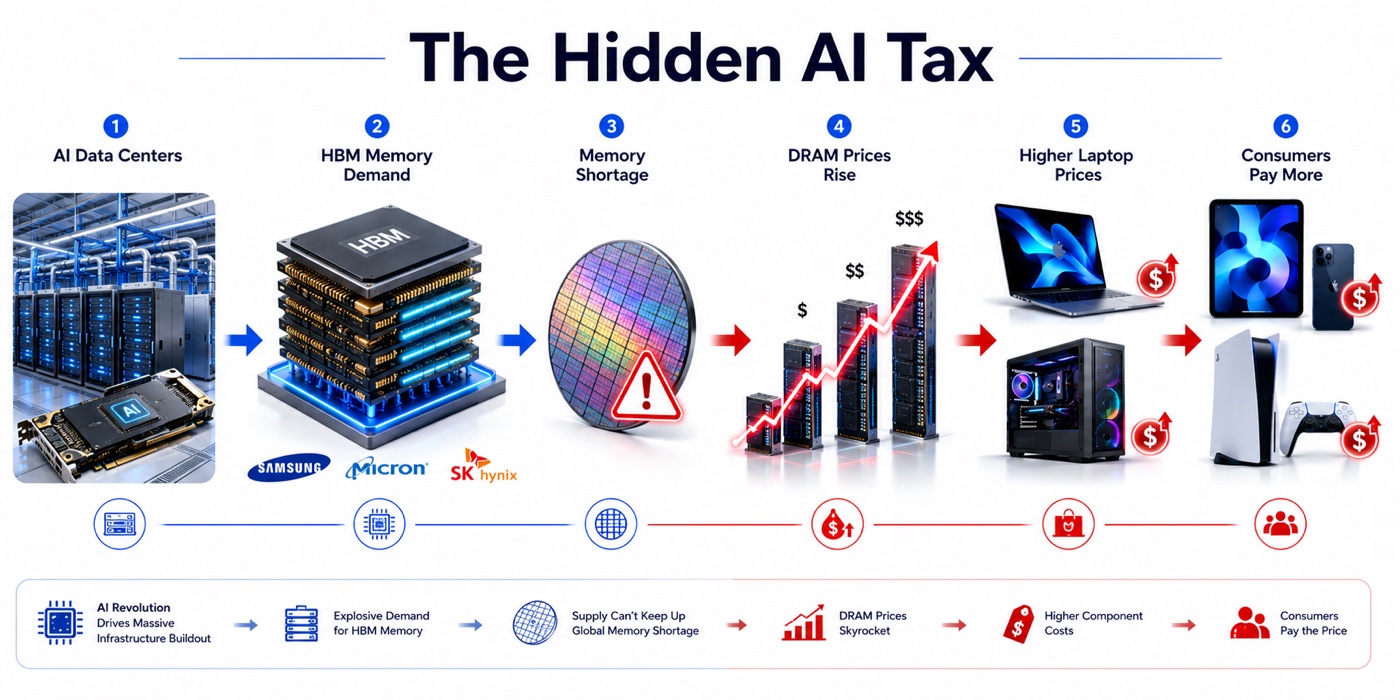
The results have shown up fast. DRAM prices reportedly rose somewhere in the range of 90% quarter-over-quarter in early 2026, with some contract prices up several-fold over the prior year; Samsung and SK Hynix have both flagged further double-digit increases for the following quarter. Apple's June price increases — and similar moves that have rippled across the PC and console industry — are the most visible way that cost has been passed on to ordinary consumers, wherever they live, in the form of more expensive laptops and gaming devices. Call it the AI tax: money that has nothing to do with buying or using AI, paid by people who never asked to be part of the trade.
The pattern behind every bubble
There's a well-worn framework in economics for how episodes like this tend to unfold, sometimes called the capital cycle. High returns attract capital. Capital keeps flowing until overcapacity is built. Overcapacity collides with reality and triggers a collapse. And, finally, most of the companies that built the boom die off, while a handful of survivors — often the ones who bought distressed assets for pennies on the dollar — end up capturing the value once real demand eventually catches up.
The clearest precedent is the telecom bubble of the late 1990s. When the US passed the Telecommunications Act of 1996, internet traffic was exploding and some founders genuinely believed bandwidth demand would double every three months. Money poured into fiber-optic buildouts: in the five years that followed, telecom companies invested more than $500 billion in cables, switches, and networks. Global Crossing reached a $47 billion valuation without ever posting a profitable year. Corvis, a fiber-equipment startup, went public at a $32 billion market cap with zero revenue.
Internet traffic did grow — by roughly 100% a year, which in almost any other context would count as spectacular — but it wasn't enough to justify the buildout. By the early 2000s, as little as 2.7% of the fiber optic cable installed in the US was actually carrying data; more than 95% sat dark underground. Bandwidth prices collapsed by as much as 90%. WorldCom, after hiding $3.8 billion in expenses to fake profitability, filed the largest bankruptcy in US history at the time. Global Crossing went under. In total, the telecom crash erased roughly $2 trillion in market value.
The twist is what happened next. The fiber didn't disappear — it sat in the ground until YouTube, streaming video, cloud computing, and the smartphone era arrived and needed exactly the capacity that had been built years earlier. The survivors bought that wrecked infrastructure for a fraction of its cost and it became the literal backbone of the modern internet — the same fiber that now carries Netflix, Google, and AWS traffic. The technology was real. The demand eventually caught up. The bubble still burst, and most of the companies that built it did not survive to see the payoff.
The same shape shows up further back. Britain authorized 9,500 miles of railway track in 1846 at the peak of railway mania; a third of it was never built, and the bubble burst anyway. It's not yet clear which chapter of that pattern 2026's data-center buildout will end up writing.
Why "definitely a bubble" is too simple
Here is the case for restraint before calling this the next dot-com. The telecom companies that collapsed in 2001 were mostly funded by debt and were losing money with no plan to stop. Nvidia, by contrast, earned roughly $120 billion in net income over the past year, and Microsoft, Google, and Amazon are among the most profitable companies that have ever existed — they are largely funding this buildout from their own cash flow, not speculative debt, even as that share of cash flow climbs uncomfortably high. Valuations, while elevated, are not at 1999-level extremes either: the NASDAQ 100's forward price-to-earnings ratio peaked around 60x at the dot-com top; today it sits closer to 26x — well above historical norms, but not in the same universe of excess.
That's the honest, uncomfortable middle ground: anyone who says this is definitely a bubble is overstating their certainty, and so is anyone who says it definitely isn't. The technology is real. The revenue, while far short of what's needed, is also real and growing quickly. The actual disagreement isn't about whether AI will change the world — it's about whether the price being paid for that future, right now, makes sense.
What happens from here
Roughly speaking, there are two paths. In the first, the bubble deflates: capital spending slows sharply, some AI-adjacent companies fail, and the ripple effects reach far beyond Silicon Valley — including the outsourcing and IT-services economies, notably in India, that have grown alongside big tech's spending. In the second, the bubble doesn't pop, but the industry races toward profitability instead, which likely means AI usage gets significantly more expensive as providers try to close the revenue gap rather than subsidize it. In that scenario, the cheap, abundant AI tools available today would become a comparative luxury, and some AI products would fail not because the technology stopped working, but because it became too expensive to run profitably. A third, much narrower possibility — a sudden collapse in the cost of running AI models paired with a surge in enterprises willing to pay for the value they get — would resolve the math cleanly for everyone. Most people who study these cycles treat it as the least likely outcome of the three.
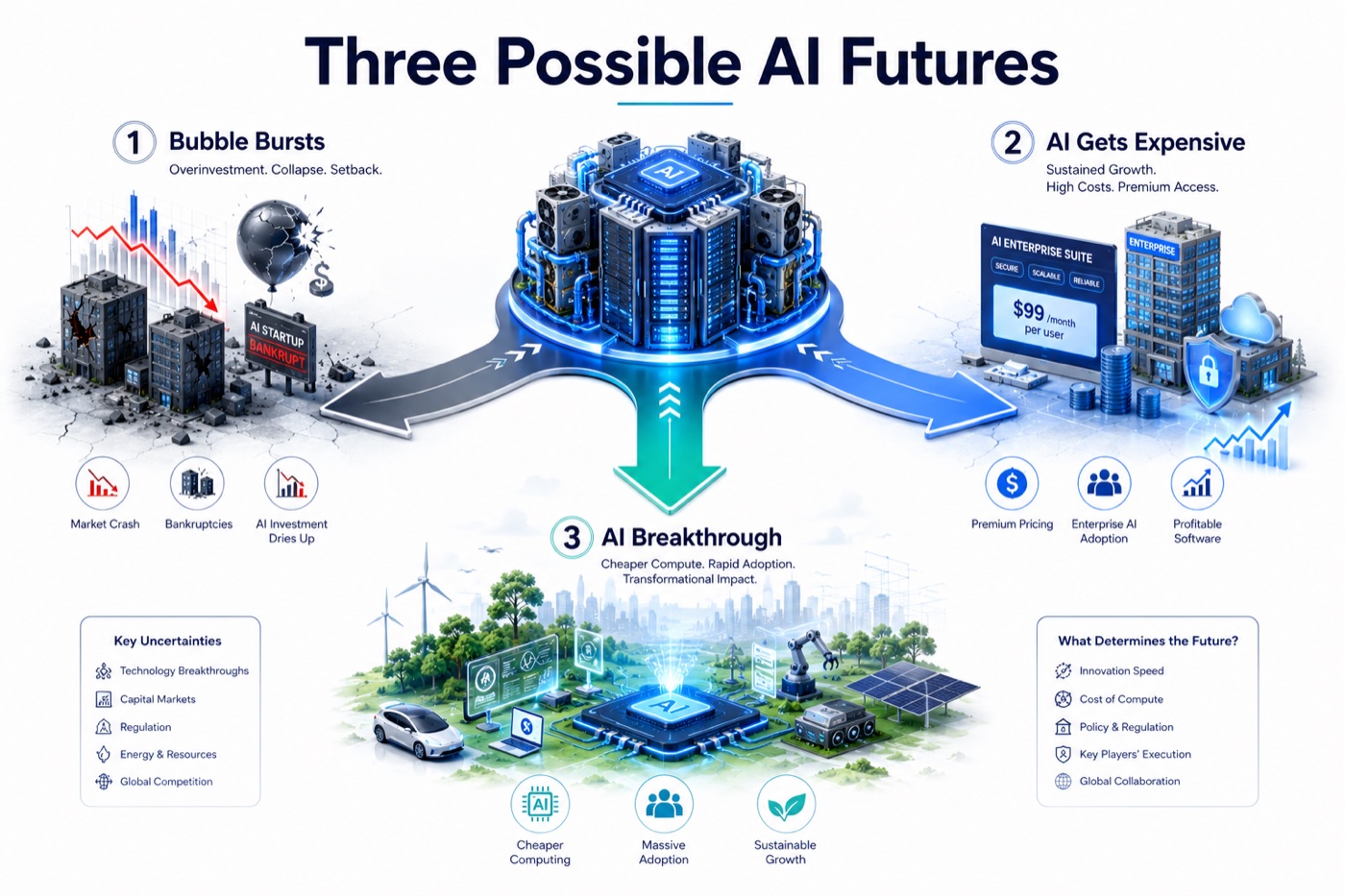
None of that will be settled by argument. It will be settled the way it always is in a capital cycle: by watching how much of what's being built actually gets used, and by whom.